Renewable Energy Project: Critical Two-Way Radio Network
MarchNet designed, delivered and supports a DMR Tier III digital trunked radio network for a major pumped hydro project in South East Queensland, with smartphone push-to-talk, RoIP and LEO satellite inter-site links.
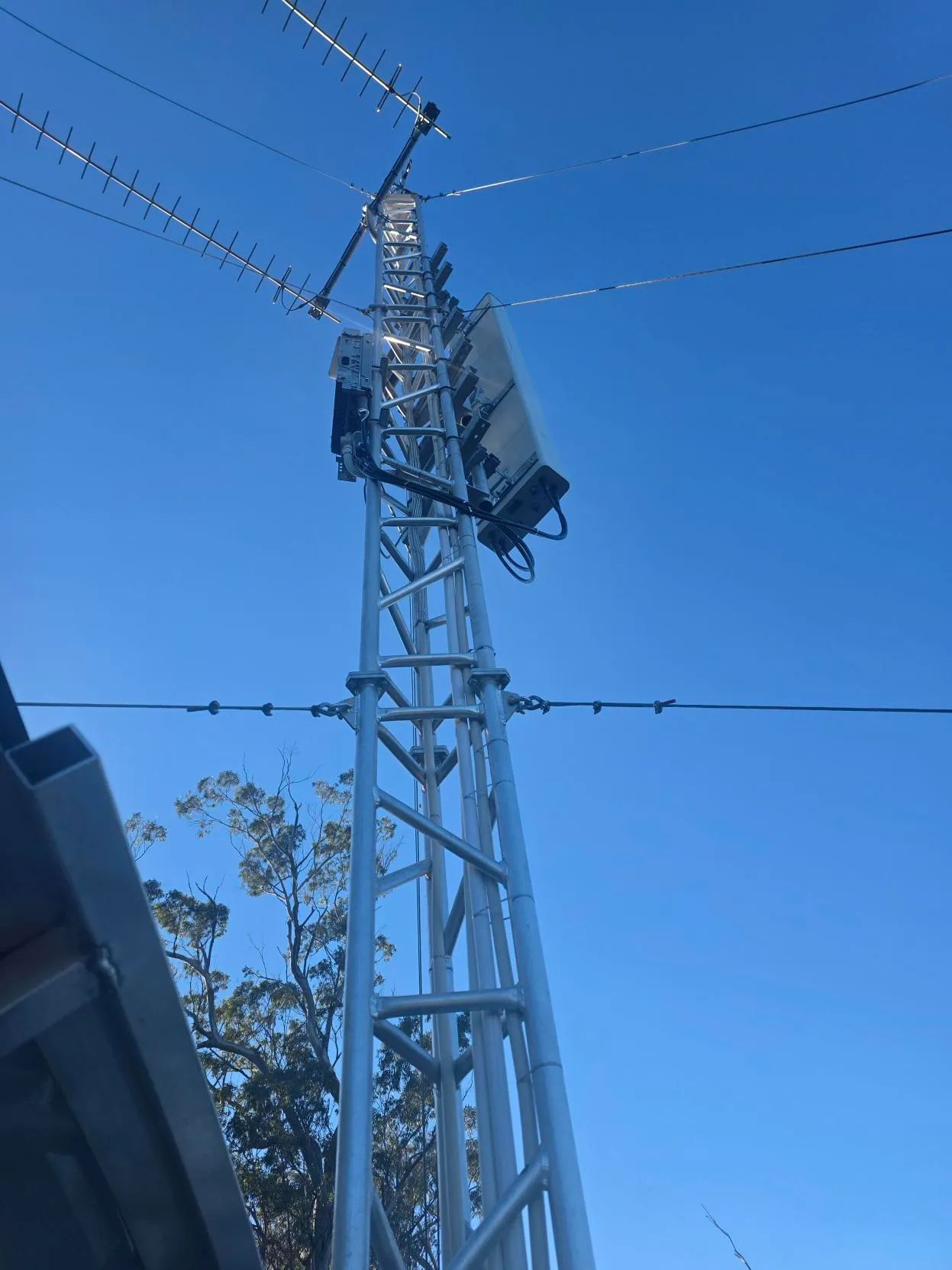
Six DMR Tier III sites, diverse backhaul and coverage beyond line of sight, across some of the most challenging terrain in South East Queensland.

Reliable radio where coverage can’t be assumed
A major pumped hydro energy storage project in the South East Queensland hinterland stretches across steep, heavily vegetated terrain, remote access roads and multiple construction and operational areas. Personnel, contractors and site activities needed dependable two-way radio in places where conventional mobile coverage and direct line of sight could not be taken for granted.
MarchNet designed and deployed a six-site DMR Tier III network across the project area, progressively adding repeater sites to close identified coverage gaps and support changing construction and operational requirements, including a specialist UHF link reaching through the trees to a heavily obstructed site.
Overlapping RF and deployment challenges
- Radio shadowing: mountainous terrain, deep gullies and dense vegetation blocked signals across much of the project area
- Dispersed work areas: reservoirs, access tracks, hilltops, workforce camps and the dam wall, spread across a large footprint
- Limited power: several locations had little or no mains power and needed standalone systems
- Practical siting: infrastructure had to go where it could be built and maintained, not just at the theoretically best RF position
- A moving footprint: coverage had to extend progressively as new construction areas became active
- No line of sight: one key site had to be connected through dense trees with no clear optical path
Designed for the terrain, and the trees
MarchNet combined desktop RF modelling, physical site surveys, terrain and vegetation analysis, coverage predictions and field validation to choose practical site locations. Coverage studies were produced for each DMR site and consolidated into project-wide outputs. The modelling went beyond terrain to account for near-field trees, with separate predictions run with and without nearby vegetation when assessing high points and infill locations.
The design was refined as the project evolved rather than treated as fixed. Coverage gaps between existing sites led to a new infill repeater on an obstructed access track, and the need for better coverage along a key access road towards a workforce camp led to a new hilltop site on existing mast infrastructure.

First-of-type: Starlink backhaul for DMR
A key innovation was MarchNet’s integration of Starlink satellite connectivity as backhaul for the DMR network. At the time of design, MarchNet was advised this architecture had not previously been implemented by the radio vendor, making it a first-of-type deployment for the parties involved.
MarchNet engineered the end-to-end IP path, routing and radio integration to link remote repeaters over Starlink where fibre and line-of-sight microwave were impractical, with remote monitoring built in. At the first sites, each repeater pairs Starlink with a high-gain 4G backup, routed through MarchNet’s managed SD-WAN platform for automatic failover.

Connectivity without clear line of sight
Dense trees obstructed the path to one of the new infill sites, ruling out a conventional clear line-of-sight microwave link. Rather than forcing a link the environment didn’t support, MarchNet deployed a specialist UHF point-to-point Ethernet link designed to work through the obstructed path. Its lower frequency penetrates vegetation far better than high-frequency microwave, connecting the remote DMR site without needing an optical path through the canopy.
The UHF link was combined with Starlink and high-gain 4G, giving the site three independent paths. The site was completed and commissioned in June 2026.
Everything needed to run in the field
Depending on location, each site combined outdoor cabinets, UHF antenna systems, solar and lithium power, diesel-supported power, high-gain 4G, Starlink, multi-WAN failover and remote monitoring. All six DMR repeaters are licensed in the 400 MHz band at up to 50 W and supported by MarchNet’s ongoing licensing, monitoring and maintenance.
Hilltop site: building on existing infrastructure
MarchNet integrated the new DMR Tier III repeater into existing mast infrastructure and upgraded the power system with a new power supply, three lithium batteries and an additional eight-panel solar skid. Starlink, 4G and existing microwave connectivity, with edge routing for path diversity and failover, extended two-way radio across a key access corridor, supporting personnel, contractors and emergency communications.
One managed network that grows with the project
The fully trunked Tier III network shares channels dynamically across all six sites, giving personnel and contractors wide-area coverage on a single managed fleet, with new sites added as the project footprint grew.

The outcome: a scalable critical communications platform
- Six-site DMR network covering dispersed operational areas and access corridors
- Fully trunked Tier III operation, backwards compatible with Tier II where required
- Targeted infill sites added as the project footprint grew
- Diverse backhaul: Starlink with high-gain 4G backup at every site, plus microwave and UHF where needed
- Remote-area power matched to each site’s conditions
- First-of-type Starlink backhaul for DMR, extending the network where fibre and microwave were impractical
- Managed licensing, monitoring, support and maintenance
- Reusable expertise: the Starlink-backed DMR design has since been applied to other remote opportunities
MarchNet delivered the whole solution as one partner, end to end: RF modelling, site surveys, spectrum licensing, civil and power infrastructure, radio engineering, backhaul design and managed services.
Selecting the technology around the actual site conditions, not forcing the textbook answer, is what connected the project.